

Students’ Satisfaction with the Quality of Educational Program Implementation for the 2024–2025 Academic Year

REPORT
Academic Year 2024–2025
The survey was conducted to enhance the quality of the educational process, obtain feedback from students enrolled in the respective educational programs and analyse their perceptions regarding key aspects of quality assurance in higher education.
The questionnaire consisted of 19 closed-ended questions requiring respondents to rate various aspects of program quality, as well as one open-ended question: “Please provide your recommendations and suggestions for improving the quality of the educational process.”
A five-point rating scale was used to assess each criterion of satisfaction with the educational program, where a score of 1 indicated the lowest level of satisfaction and a score of 5 indicated the highest level of satisfaction.
The survey items were grouped into five thematic sections:
- Satisfaction with the Program Structure;
- Satisfaction with the Educational and Methodological Support of the Program;
- Satisfaction with the Conditions for Program Delivery;
- Satisfaction with the Material and Technical Resources Supporting the Program;
- Overall Satisfaction with the Quality of Educational Services Provided within the Program.
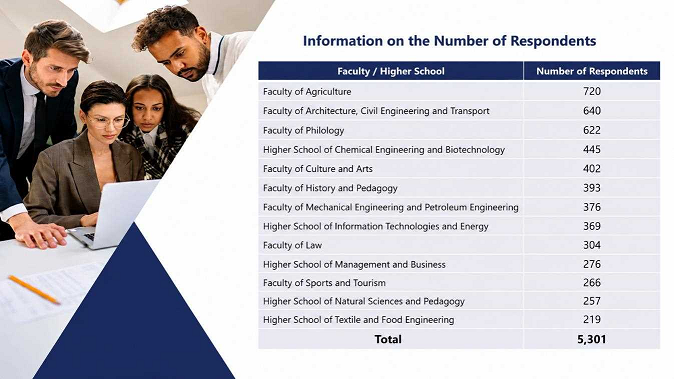
The survey covered 5,301 full-time students across 34 fields of study, including 108 bachelor's degree programs, 27 master's degree programs, and 12 doctoral programs.
The questionnaire was administered electronically via the Google Forms platform. Students were informed about the survey through social media student groups, group chats in messaging applications, and email notifications.
The resulting sample may be considered representative, as it included more than half of the students enrolled in the educational programs under review. This level of participation provides a reliable basis for analysing student perceptions and evaluating the quality of educational program delivery.
Information on the number of survey participants by faculty and higher school is presented in the following slide.
Slide 2 Information on the Number of Respondents
Distribution of Survey Respondents by Faculty and Higher School.
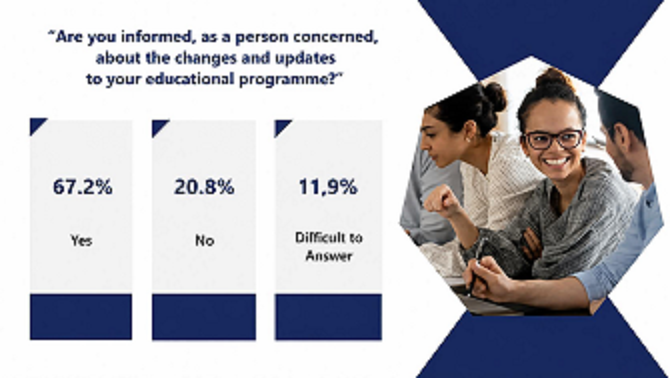
The findings revealed that 67.2% of students were aware of changes and updates introduced to their educational programы, whereas 20.8% indicated a lack of awareness. Compared with the previous academic year, the proportion of informed students decreased from 71.4% to 67.2%, while the percentage of uninformed students increased from 18.9% to 20.8%. In the previous survey cycle, 9.7% of respondents reported uncertainty regarding this issue.
Slide 3
A detailed analysis of the survey results by educational program is presented in Slides 4–5.
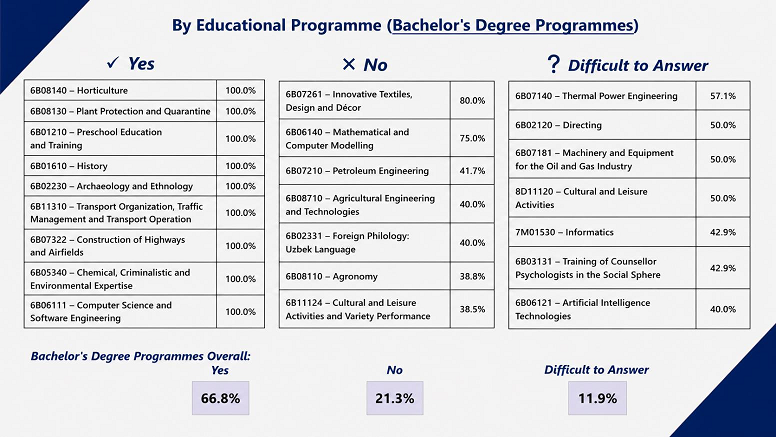
Undergraduate Programs (Bachelor's Degree): Students enrolled in the following Educational Programs (EPs) demonstrated the "highest level of awareness":
- 6B01610 – History;
- 6B07322 – Highway and Airfield Construction;
- 6B05340 – Chemical, Forensic, and Environmental Examination, etc.
The following Educational Programs (EPs) were identified as "unaware / lack of awareness":
- 6B07261 – Innovative Textiles, Design, and Decor;
- 6B06140 – Mathematical and Computer Modelling;
- 6B07210 – Petroleum Engineering.
Breakdown by Educational Programs: (IHEI / Institute of Higher and Postgraduate Education)
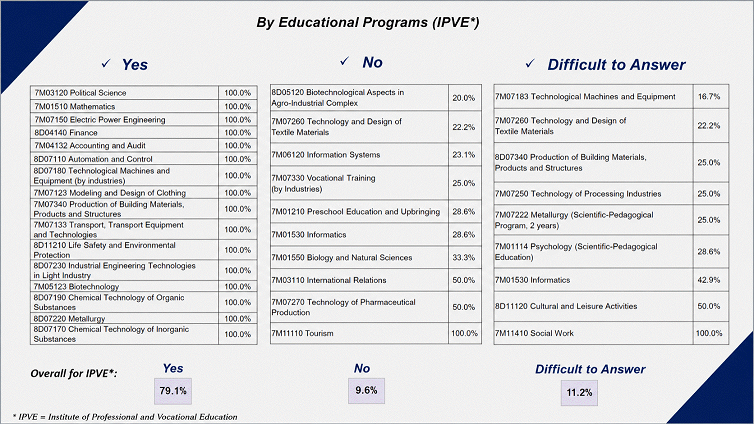
Institute of Higher and Postgraduate Education (IHEI): Students enrolled in the following Educational Programs (EPs) demonstrated the "highest level of awareness":
- 7M01510 – Mathematics;
- 7M03120 – Political Science;
- 7M05123 – Biotechnology.
The following Educational Programs (EPs) were identified as "unaware / lack of awareness":
- 7M11110 – Tourism;
- 7M07270 – Technology of Pharmaceutical Production;
- 7M03110 – International Relations.
Slide 6
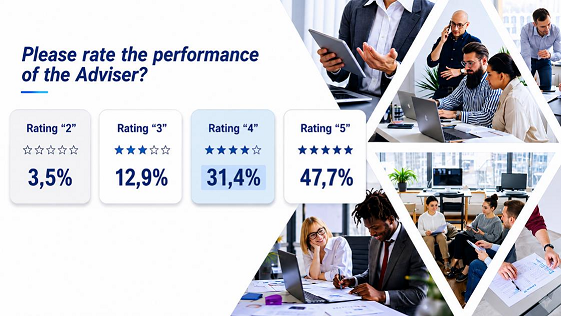
The performance of "academic advisors" was evaluated as follows:
- Excellent: 47.7% of respondents rated it as "excellent" university-wide (compared to 43.1% in the previous year);
- Good: 31.4% of respondents rated it as "good" university-wide (compared to 32.8% in the previous year);
- Unsatisfactory / Poor (Failing grade "2"): 3.5% of respondents gave a rating of "2" (compared to 4.7% in the previous year).
Slide 7
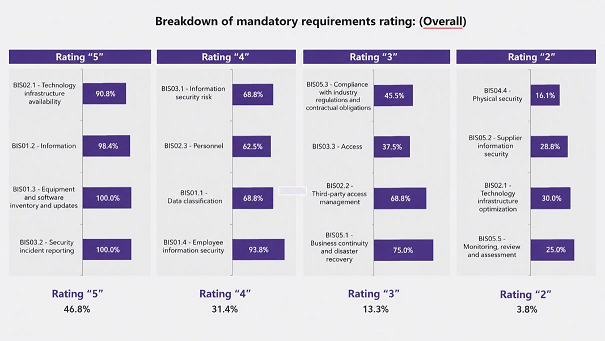
Undergraduate Programs (Bachelor's Degree): The performance of academic advisors was rated as "excellent" in the following Educational Programs (EPs):
- 6B08130 – Plant Protection and Quarantine;
- 6B01210 – Pre-school Education and Upbringing Pedagogy;
- 6B04120 – Management.
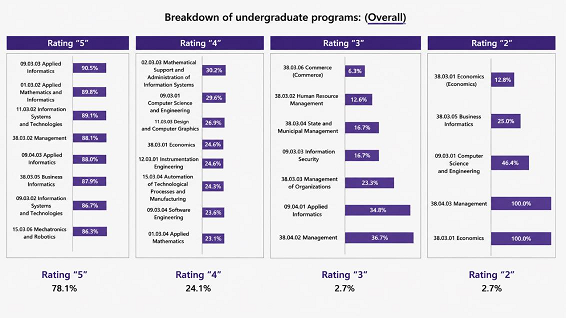
Institute of Higher and Postgraduate Education (IHEI): The performance of academic advisors was rated as "excellent" in the following Educational Programs (EPs):
- 8D07170 – Chemical Technology of Organic Substances;
- 8D07220 – Metallurgy;
- 8D07180 – Technological Machines and Equipment (by industry).
Slide 9
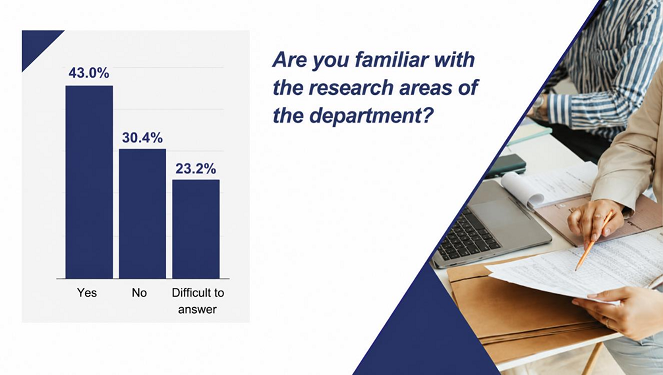
In response to the question "Are you familiar with the research areas of the department?", 43.8% of respondents answered "yes," while 32.4% stated they were unfamiliar. In the previous academic year, 45.5% of respondents indicated they were familiar, 31.0% were not, and 23.5% found it difficult to answer.
Slide 10
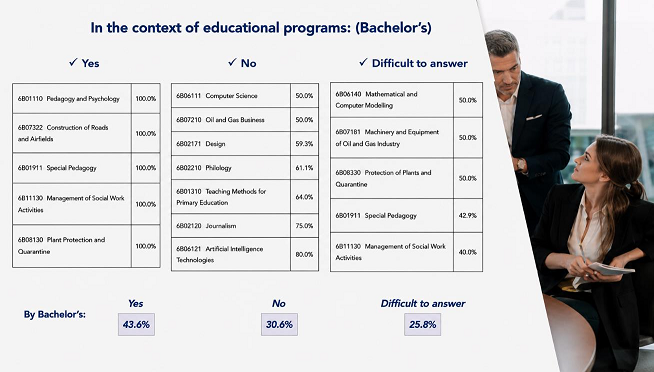
Overall Bachelor's Affirmative Rate: 42.8%
2. Programs with Low Stakeholder Confirmation
The programs below recorded negative response rates between 60.0% and 80.0%, indicating limited stakeholder familiarity or insufficient alignment with current professional standards.
✗ No
|
Program Code |
Program Title |
Negative Rate (%) |
|
6B06210 |
Radio Engineering, Electronics and Telecommunications |
60.0% |
|
6B07261 |
Innovation, Textile Design and Décor |
60.0% |
|
6B11130 |
Management of Cultural and Leisure Activities |
60.0% |
|
6B07401 |
Agricultural Engineering (Food Technology) |
70.0% |
|
6B06120 |
Mathematics and Computer Modeling |
70.0% |
|
6B05340 |
Chemical, Criminalistics and Environmental Expertise |
75.0% |
|
6B01420 |
Music Education |
80.0% |
|
6B02331 |
Foreign Philology: Uzbek Language |
80.0% |
Overall Bachelor's Negative Rate: 33.4%
3.Programs Requiring Further Assessment
The following programs received inconclusive responses, with a notable proportion of stakeholders indicating uncertainty. These programs are recommended for targeted follow-up evaluation.
✱ Difficult to Answer
|
Program Code |
Program Title |
Undecided (%) |
|
6B02120 |
Directing |
50.0% |
|
6B02140 |
Fine Arts (Painting) |
50.0% |
|
6B05330 |
Expertise of Substances and Materials in Chemical Engineering |
50.0% |
|
6B01110 |
Pedagogy and Psychology |
57.1% |
|
6B04214 |
Law and Law Enforcement Activities |
58.8% |
Overall Bachelor's Undecided Rate: 23.9%
4. Aggregate Summary — Bachelor's Programs
Overall Bachelor's Undecided Rate: 23.9%
|
Response Category |
Aggregate Rate (%) |
|
Affirmative (Yes) |
42.8% |
|
Negative (No) |
33.4% |
|
Undecided (Unable to Assess) |
23.9% |
Analysis by Educational Program:
Among Bachelor's programs, the following recorded a 100% affirmative response — all surveyed respondents confirmed familiarity with the department's research areas:
- 6B11310 — Organization, Management and Operation of Transport
- 6B08130 — Protection and Quarantine of Plants
- 6B07322 — Construction of Roads and Aerodromes
Slide 11
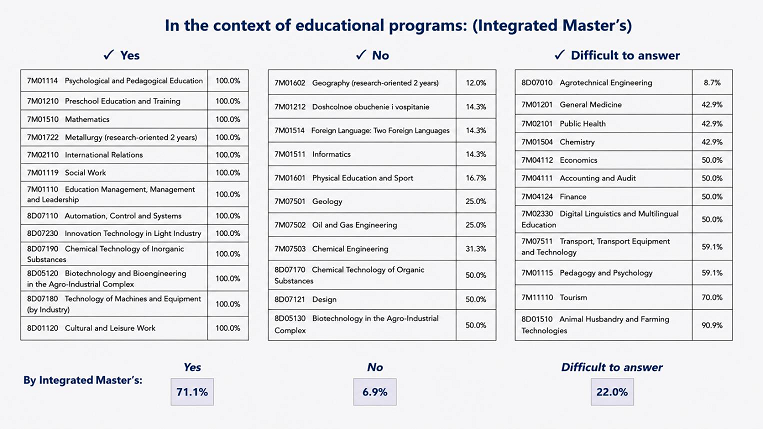
By Educational Programs (IPHE)
According to the responses collected from IPHE representatives, 100% of respondents answered "Yes" — confirming their familiarity with the research directions of the department — for the following educational programs:
- 8D11120 — Cultural and Leisure Studies;
- 8D07340 — Production of Construction Materials, Products, and Structures;
- 8D07230 — Innovative Technologies in Light Industry.
Slide 12
Are the contents of the disciplines in your educational program aligned with the research directions of the department?
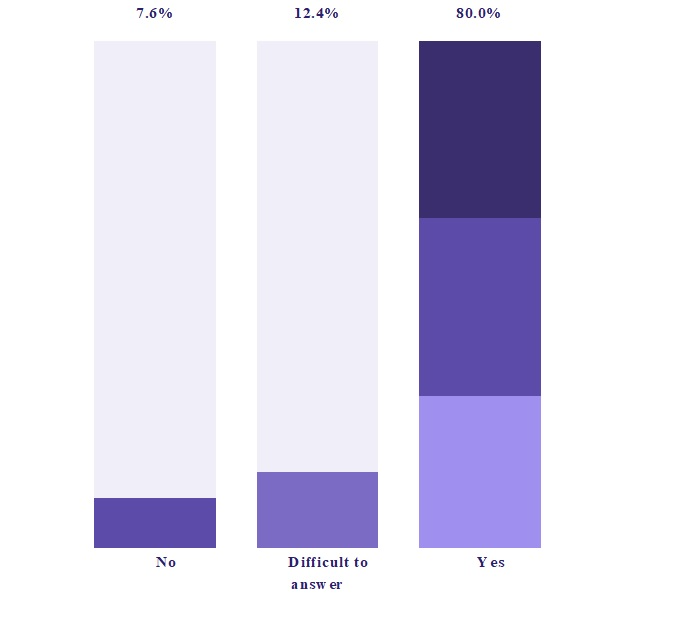
In response to the question "Are the contents of the disciplines in your educational program aligned with the research directions of the department?", 80.0% of respondents indicated that the disciplinary content of their educational program is aligned with the research directions of the department, 7.6% considered them to be not aligned, and 12.4% were unable to provide a definitive answer.
In the preceding year, 80.6% of respondents reported that the disciplinary content of their educational program is aligned with the research directions of the department, while 7.7% considered the disciplinary content to be not aligned with the research directions of the department.
Slide 13
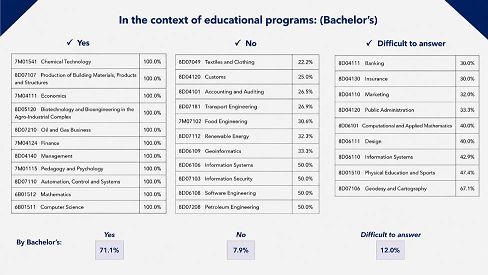
In the breakdown by educational programs, 100% of students responded that the curriculum content and the department's research areas are "linked" as follows:
Undergraduate Programs (Bachelor's Degree):
- 6B01541 – Chemistry-Biology;
- 6B01610 – History;
- 6B07181 – Machinery and Equipment for the Oil and Gas Industry.
Slide 14
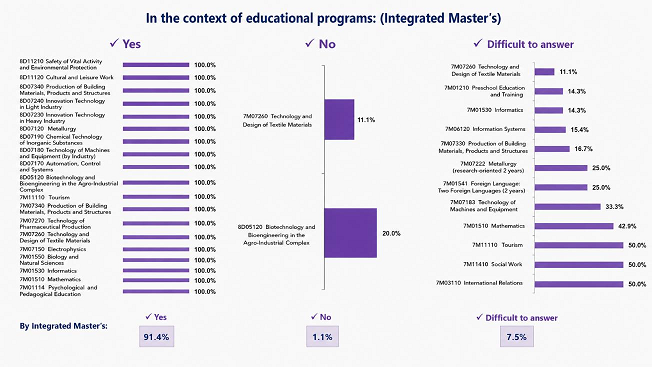
Breakdown by Educational Programs: (IHEI)
Institute of Higher and Postgraduate Education (IHEI):
- 8D11210 – Life Safety and Environmental Protection;
- 8D11120 – Cultural and Leisure Work;
- 8D07240 – Innovative Technologies in Manufacturin
Slide 15
SURVEY ANALYSIS REPORT (ACCREDITATION)
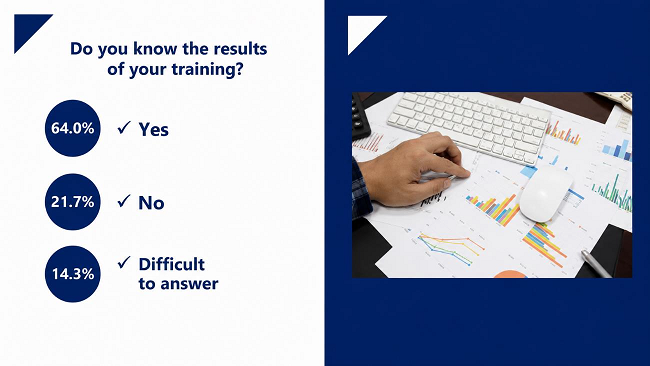
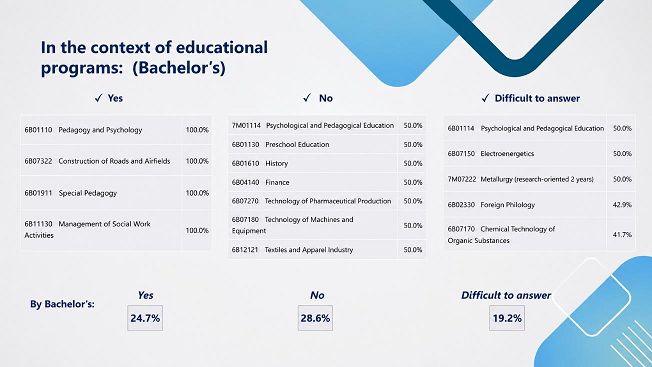
In response to the question "Are you familiar with the learning outcomes of your Educational Program (EP)?", the current results indicate that 54.0% of respondents "are aware of the EP learning outcomes," 21.7% are not aware, and 24.4% found it difficult to answer.
By comparison, in the previous academic year, 56.1% of respondents "were aware of the EP learning outcomes," 20.3% "were unaware of the EP learning outcomes," and 23.6% found it difficult to answer.
Slide 16
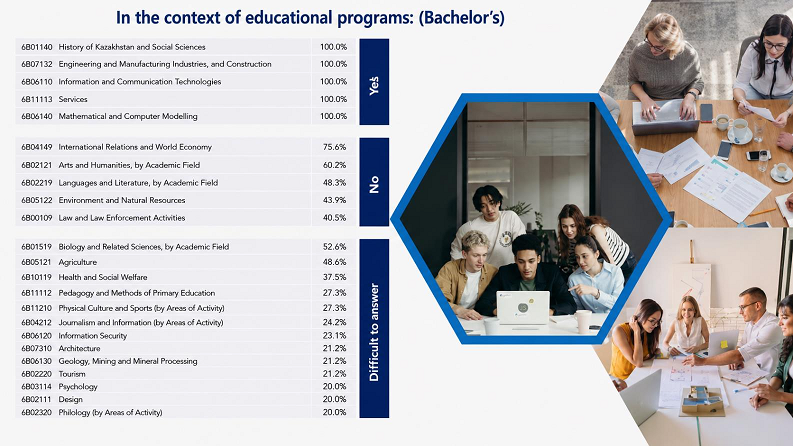
In the Context of Educational Programs: Bachelor's Degree
Undergraduate Programs (Bachelor's Degree):
- 6B07181 – Machinery and Equipment for the Oil and Gas Industry;
- 6B07322 – Construction of Highways and Airfields;
- 6B08140 – Fruit and Vegetable Production.
Slide 17
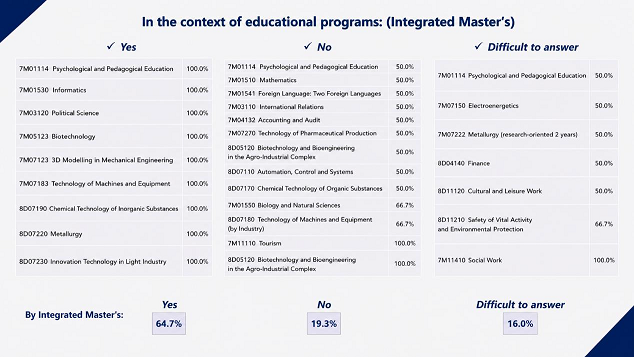
In the Context of Educational Programs: ISBO (Master's Degree)
✗ NO — Programs with Low or No Graduate Employment Alignment
|
Program Code & Title |
Rate |
|
5D06120 – Biotechnological Agents in the Agro-Industrial Complex |
60.0% |
|
7M07123 – 3D Modeling in Mechanical Engineering |
60.0% |
|
7M01680 – Biology and Natural Science |
33.3% |
|
7M01620 – Physics |
25.0% |
|
7M07222 – Metallurgy (Science and Pedagogical, 2 years) |
25.0% |
|
7M07330 – Water Supply, Sewerage and Industry |
25.0% |
|
7M01210 – Distance Learning and Consulting |
14.3% |
|
7M06120 – Information Systems |
7.7% |
◑ DIFFICULT TO ANSWER — Programs with Uncertain Alignment
|
Program Code & Title |
Rate |
|
7M11110 – Tourism |
100.0% |
|
7M01630 – Informatics |
87.1% |
|
7M01641 – Chemistry (Science and Pedagogical, 2 years) |
80.0% |
|
7M03110 – International Relations |
80.0% |
|
7M07183 – Technology of Machines and Equipment |
80.0% |
|
7M07222 – Metallurgy (Science and Pedagogical, 2 years) |
80.0% |
|
7M07270 – Technology of Pharmaceutical Production |
80.0% |
|
6D07110 – Automation, Control and Systems |
80.0% |
|
6D07170 – Chemistry of Organic Compounds |
80.0% |
|
6D11120 – Cultural Studies Work |
80.0% |
✓ YES — Programs with Full Graduate Employment Alignment
|
Program Code & Title |
Rate |
|
7M03120 – Political Science |
100.0% |
|
7M04120 – Management (Science and Pedagogical, 2 years) |
100.0% |
|
7M04130 – Accounting and Auditing |
100.0% |
|
7M07270 – Technology of Pharmaceutical Production |
100.0% |
|
7M07340 – Production of Building Materials, Products and Structures |
100.0% |
|
7M11410 – Social Work |
100.0% |
|
5D04140 – Finance |
100.0% |
|
6D07150 – Technology of Machines and Equipment (by Industry) |
100.0% |
|
6D07120 – Chemical Technology of Fuels |
100.0% |
|
6D07220 – Metallurgy |
100.0% |
|
6D07340 – Production of Building Materials, Products and Structures |
100.0% |
|
7M07133 – Logistics of Transport Systems |
91.7% |
Institute of Higher and Postgraduate Education (IHEI):
- 7M04132 – Accounting and Auditing;
- 7M11410 – Social Work;
- 7M04120 – Management (Scientific and Pedagogical Track, 2 years).
Slide 18
Were Students Given a Choice of Disciplines?
Survey results by bachelor's degree program. Respondents were asked whether they were provided an opportunity to choose their academic disciplines.
|
YES 42.8% (42.3% by program) |
NO 38.9% (39.4% by program) |
UNSURE 18.3% (18.2% by program) |
|
Bachelor's Program |
% Yes / No / Unsure |
|
YES — Given a Choice (overall: 42.8%) |
|
|
6B07340 – Production of Building Materials |
80.8% |
|
6B07510 – Standardization and Certification (by industry) |
83.3% |
|
6B07130 – Transport, Transport Equipment and Technology |
83.8% |
|
6B01110 – Pedagogy and Psychology |
85.7% |
|
6B04120 – Management |
93.7% |
|
6B07322 – Construction of Roads and Airfields |
100.0% |
|
6B11310 – Organization of Transportation, Traffic Management and Transport Operations |
100.0% |
|
NO — Not Given a Choice (overall: 38.9%) |
|
|
6B07140 – Heat Power Engineering |
71.4% |
|
6B01310 – Pedagogy and Methods of Primary Education |
72.0% |
|
6B01541 – Chemistry-Biology |
80.0% |
|
6B07261 – Innovative Textiles, Design and Decor |
80.0% |
|
6B01420 – Music Education |
85.7% |
|
6B01610 – History |
100.0% |
|
UNSURE (overall: 18.3%) |
|
|
6B01911 – Special Education |
42.9% |
|
6B08130 – Plant Protection and Quarantine |
50.0% |
|
6B05330 – Expert Analysis of Substances and Materials in Chemical Engineering |
62.5% |
|
6B06140 – Mathematical and Computer Modelling |
100.0% |
Survey Analysis: Student Choice of Elective Disciplines
In response to the questionnaire regarding the opportunity to choose elective disciplines, 42.8% of respondents stated that they have the opportunity to choose, 38.9% indicated they do not have a choice, and 18.3% found it difficult to answer.
In comparison, during the previous academic year, 46.8% of respondents indicated that students were provided with such an opportunity, 36.0% of respondents lacked a choice, and 17.2% found it difficult to answer.
Slide 19
Were Students Given a Choice of Disciplines? (IPVO Programs)
Survey results by Integrated Post-Graduate/Higher Vocational Education (IPVO) program. Respondents were asked whether they were provided an opportunity to choose their academic disciplines.
|
YES 55.6% |
NO 25.7% |
UNSURE 18.7% |
|
IPVO Program |
% Yes / No / Unsure |
|
YES — Given a Choice (overall: 55.6%) |
|
|
7M03120 – Political Science |
100.0% |
|
7M07123 – 3D Modelling in Mechanical Engineering |
100.0% |
|
7M07340 – Production of Building Materials, Products and Structures |
100.0% |
|
8D07170 – Chemical Technology of Organic Substances |
100.0% |
|
8D07220 – Metallurgy |
100.0% |
|
NO — Not Given a Choice (overall: 25.7%) |
|
|
8D07180 – Technology of Machinery and Equipment (by industry) |
66.7% |
|
7M11110 – Tourism |
100.0% |
|
8D05120 – Biotechnological Aspects in the Agro-Industrial Complex |
100.0% |
|
8D05120 – Biotechnological Aspects in the Agro-Industrial Complex |
100.0% |
|
UNSURE (overall: 18.7%) |
|
|
7M01520 – Physics |
50.0% |
|
7M01132 – Chemistry Audit |
50.0% |
|
7M07222 – Metallurgy (Scientific-Pedagogical, 2 years) |
50.0% |
|
7M07250 – Technology of Processing Industries |
50.0% |
|
7M07170 – Technology of Pharmaceutical Production |
50.0% |
|
7M01230 – Chemistry |
50.0% |
|
8D11120 – Multicultural Social Work |
50.0% |
|
8D11210 – Life Safety and Environmental Protection |
66.7% |
|
7M11410 – Social Work |
100.0% |
Institute of Higher and Postgraduate Education (IHEI):
- 7M05123 – Biotechnology – 80%
- 8D07220 – Metallurgy – 100%
- 7M07123 – 3D Modeling in Mechanical Engineering – 100%
Slide 20
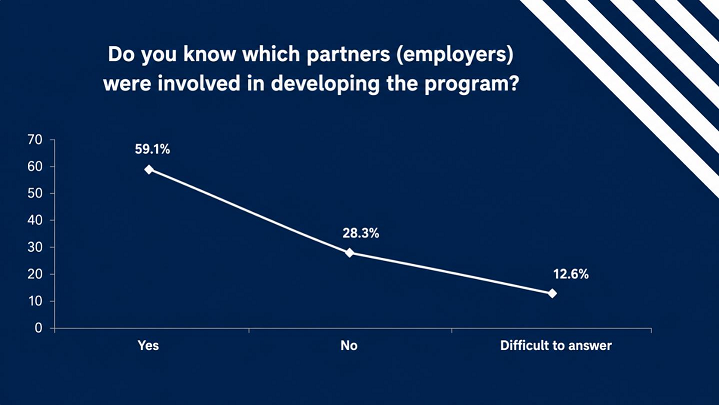
Do You Know Which Partners (Employers) Were Involved in Developing the Educational Program?
Survey results showing student awareness of employer partners who participated in the development of the educational program (OP).
Key Finding
A majority of students (59.1%) are aware of the employer partners involved in developing their educational program. However, over 40% either do not know (28.3%) or are unsure (12.6%), indicating room for improvement in communicating industry partnerships to students.
|
Response |
Share of Respondents |
|
Yes — aware of which employer partners were involved in developing the educational program |
59.1% |
|
No — not aware of which employer partners were involved |
28.3% |
|
Difficult to say / Unsure |
12.6% |
Survey Analysis: Stakeholder (Employer) Involvement in Curriculum Development
In response to the question "Are you aware of which partners (employers) were involved in the development of the Educational Program (EP)?", the current results show that 59.1% of respondents are aware of the partners involved in the EP development, 28.3% are not aware, and 12.6% found it difficult to answer.
In comparison, during the previous academic year, 57.1% of respondents indicated that they were aware of the partners involved in the curriculum development, 29.4% of respondents were unaware of the partners involved, and 13.2% found it difficult to answer.
Slide 21
Slide 22
Slide 23
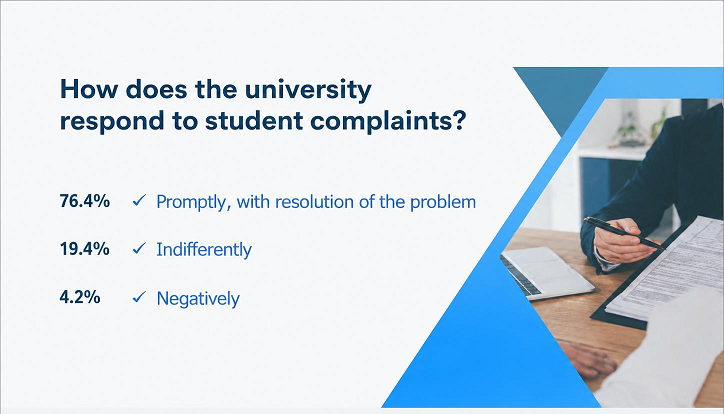
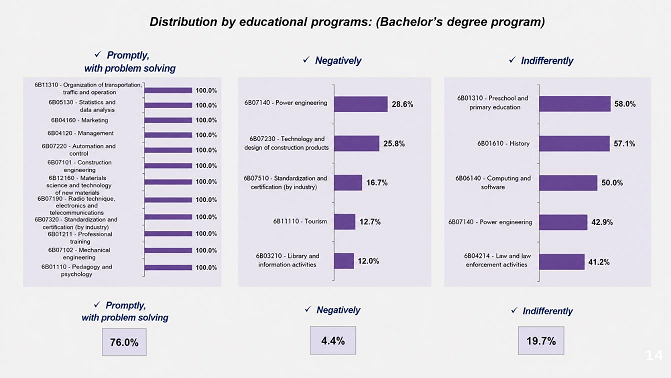
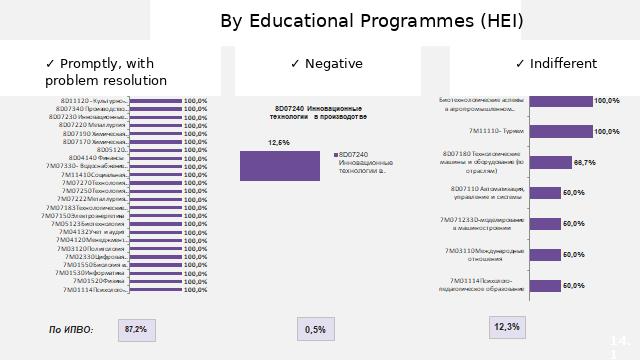
76.4% of respondents believe that the university responds to complaints promptly and with problem resolution, while 19.4% indicated that the response is indifferent, and 4.2% reported a negative response. In the previous academic year, 74.3% of respondents believed that the university responded to complaints promptly and with problem resolution, 22.3% considered the response indifferent, and 3.5% assessed it as negative.
An analysis by educational program is presented on Slides 24 and 25.
Slide 24
Slide 25
Slide 26
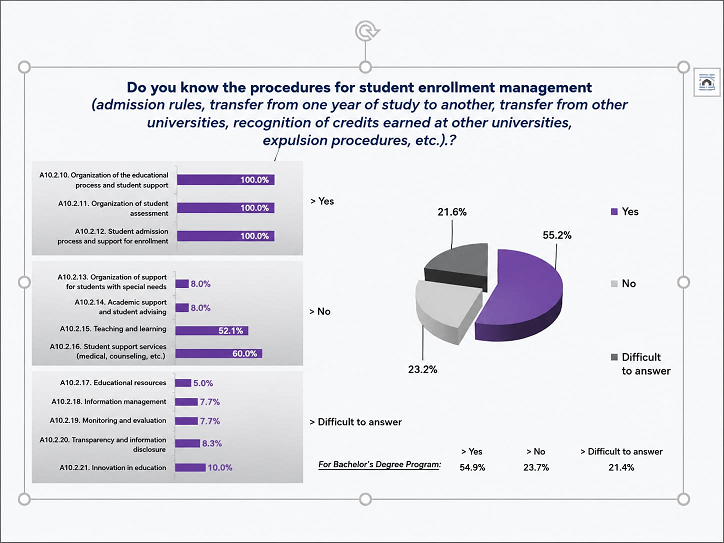
As shown in Slide 26, 55.2% of respondents are aware of all regulations and procedures related to student body formation (admission rules, progression from one year of study to another, transfer procedures, etc.), while 23.2% are not aware of them and 21.5% found it difficult to answer.
In the previous academic year, 54.0% of respondents reported being aware of all regulations and procedures related to student body formation (admission rules, progression from one year of study to another, transfer procedures, etc.), whereas 25.0% indicated that they were not aware of them.
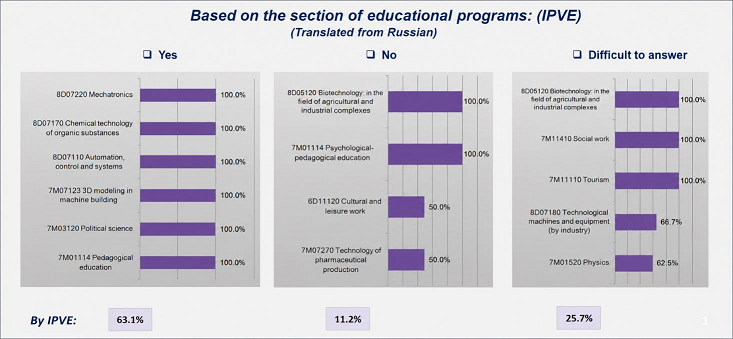
An analysis by educational program is presented in Slides 26 and 27.
Slide 27
Slide 28
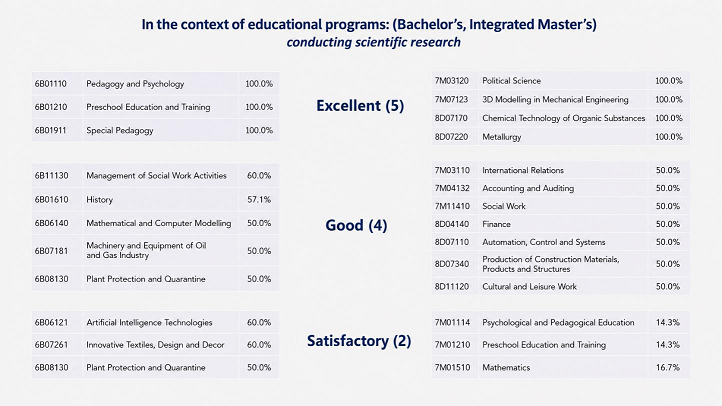
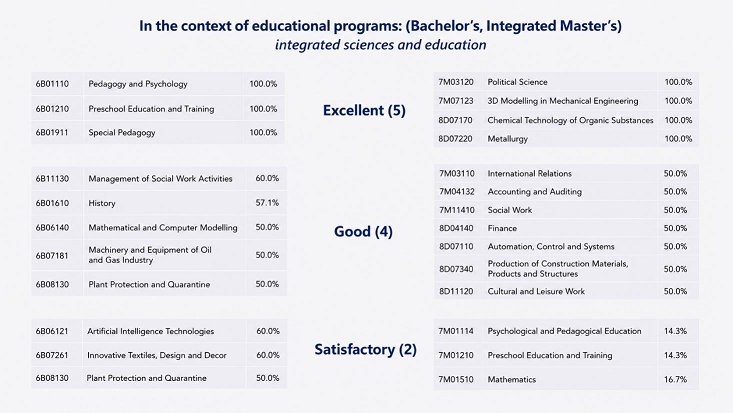
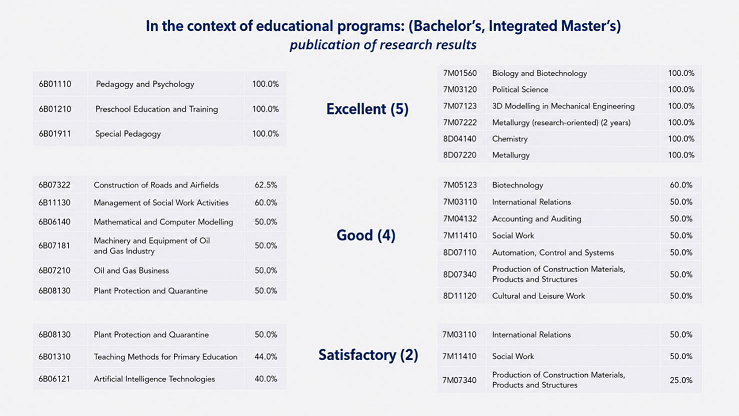
Slide 28 presents the results of students’ evaluation of the adequacy of the conditions created by the University.
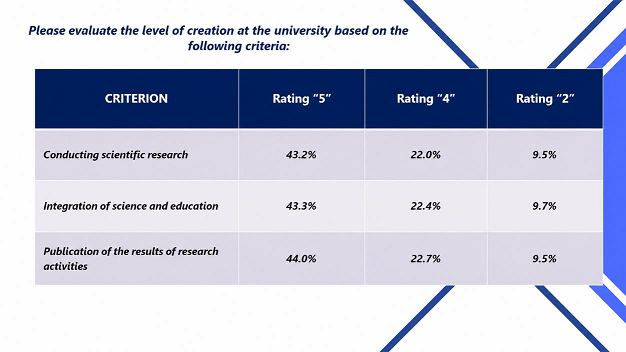
As indicated in Slide 4, 43.2% of students assessed the “Conduct of scientific research” as “excellent”. The “integration of science and education” received an “excellent” rating from 43.3% of respondents, while 44.0% of students rated the “publication of research results” as “excellent”. Slides 29–31 provide the results disaggregated by educational programm (EP).
Slide 29
Slide 30
Slide 31
Slide 32
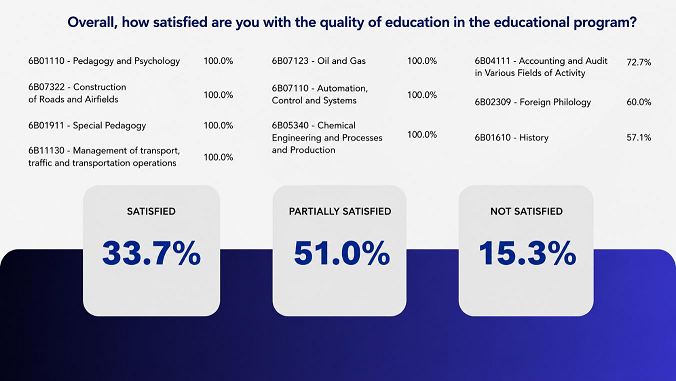
Overall, 33.7% of respondents assessed the quality of the educational programmes (EPs) as “excellent”, 51.0% as “satisfactory”, and 15.3% as “unsatisfactory”. The breakdown of the results by educational programme (EP) is presented in Slides 32 and 33.
Slide 33
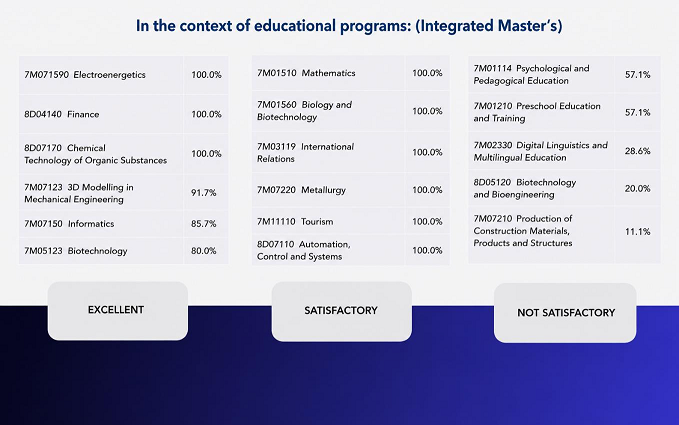
In conclusion, we would like to draw your attention once again to the following aspects:
- Heads of departments whose students are not aware of changes in EPs — 6B07261 Innovative Textile, Design and Decoration, 6B06140 Mathematical and Computer Modelling, 7M11110 Tourism, 7M07270 Pharmaceutical Production Technology, 7M03110 International Relations, etc. — are requested to conduct explanatory meetings on the changes introduced in the EPs.
- Academic advisors of the EPs presented in the slides are required to intensify their work.
- Since 32.4% of respondents are not familiar with the scientific directions of the departments, the staff responsible for student research activities (SRW) in the following EPs — 6B02331 Foreign Philology: Uzbek Language, 6B01420 Music Education, 6B05340 Chemical, Forensic and Environmental Expertise, 6B06140 Mathematical and Computer Modelling, 7M03110 International Relations, 8D05120 Biotechnological Aspects in the Agro-Industrial Complex — are required to familiarize students with the scientific directions of their departments.
- Since 38.9% of respondents believe that students are not provided with opportunities to choose elective disciplines, academic advisors of the respective EPs are requested to explain the procedure for elective course selection.
- Since 28.3% of respondents are not aware of the partners involved in the development of EPs, academic advisors of the following EPs — 6B06121 Artificial Intelligence Technologies, 6B02120 Directing, 6B01310 Primary Education Pedagogy and Methods, 7M11110 Tourism, 7M01550 Biology and Natural Sciences, 8D07180 Technological Machines and Equipment (by fields) — are required to inform students about the partners involved in EP development.
- Since 23.2% of respondents are not aware of all regulations and procedures for student body formation (admission rules, academic progression rules, etc.), academic advisors of the following EPs — 6B07261 Innovative Textile, Design and Decoration, 6B07140 Heat Power Engineering, 6B07510 Standardization and Certification (by fields), 6B05340 Chemical, Forensic and Environmental Expertise, 8D05120 Biotechnological Aspects in the Agro-Industrial Complex, 7M07270 Pharmaceutical Production Technology, 8D11120 Cultural and Leisure Work, etc. — are required to familiarize students with these academic regulations (AR).
- Chairs of Academic Quality Committees are requested to discuss and analyse the survey results in detail and develop an action plan for corrective measures.
- Deans of faculties/schools are responsible for ensuring the implementation of the corrective action plan.